

Pilot questionnaire for Heads of Care, New development of the Map of Tendencies
Autor: Adrià G.Font / 23 February de 2017
23 February de 2017
RESULTS OF THE SURVEY OF THE HEADS OF CARE OF THE SISCAT
On HC3
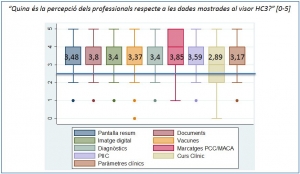
The box chart shows that from the healthcare viewpoint, all items of the HC3 visor score on the average value (represented by a blue line at the value of 2.5). We especially point to the dispersal (little consensus) in the assessments of the PCC/MACA Marking and the Clinical Course. Therefore, the general assessment is very positive.
Similarly, the survey questions the Heads of Care on whether they would consider it to be useful to view the information on social services in the HC3: more than ninety percent stressed the potential usefulness of incorporating social diagnoses and PIA reports.
On mHealth
The survey shows that mobility, despite being one of the strategic elements of the ICT-Health relationship, is in a very latent state, especially regarding the initiative of the SISCAT providers: 90% of the Heads of Care who answered declare that their institution does not have healthcare apps.
This result is coherent with the scepticism over the potential savings of apps. The results show that only roughly half of the Heads of Care, and for some specific reasons, believe that the apps would reduce costs. This view may be conditioned by the previously mentioned lack of experience in this area.
On Cat@Salut La Meva Salut
Although it is true that most centres say they offer web services (understood as any kind of online interaction) to connect with citizens, it is of interest to deal with the digitalisation strategy of centres as yet in the early stages of a digital culture.
The survey therefore questions what are the future plans of the surveyed centres when relating to citizens. Among the three most common answers, and compensating the scepticism shown with respect to mobility in the previous section, the prescription of own apps leads the future plans, followed by solutions to adherence to treatment and notification of results, areas where consensus over their applicability is much more consolidated.
Conclusions
Although it is true that the results of the pilot survey have to be interpreted in accordance with the potential selection bias (a sample answers that might not be representative of the whole), we can conclude that the results combine both experiences in use and success and doubts over the added value of technologies in the healthcare process. The good relationship can be seen between the healthcare professionals and the HC3 visor; however, we highlight the caution in the future view of mobility. Despite the projects planned or already under development, which show the expectations of added value in terms of healthcare, the professionals are moderate in expecting the costs of the system to be reduced.
Fundació TicSalut views very positively both the interest and the answers produced, and the potential added value of the results, which encourage them to consolidate the pilot survey and to include the healthcare/citizens’ view in the next edition of the Map of Tendencies.
Consult the report and results of the survey here