


The ÚNICAS project was born to create an ecosystem of alliances to help paediatric patients with complex minority diseases during their entire care process (from beginning to end).
Under the umbrella term Personalised Digital Care Plan funded by the Recovery, Transformation, and Resilience Plan as well as the Next Generation European funds, Catalonia leads the ÚNICAS project technology development and implementation. TIC Salut Social Foundation is in charge of this, evaluate the autonomous communities’ technology maturity, define the project’s basic tool technology requirements, make sure they are developed, and unfold a network of nodes.
The Sant Joan de Déu Hospital in Barcelona and the Autonomous Community of Madrid are the leaders. As support, 5 functional groups comprised of over 150 experts from all autonomous communities were created to tackle the project’s needs.
ÚNICAS wishes to offer the national health system personalised online care that provides a comprehensive service within the entire country. For this reason, the urge to create a technology platform composed of a network of nodes that makes use of the same tools, processes, and protocols in each autonomous community and allows:
- To care for paediatric patients with minority diseases at any point in the UNICAS network as is they were in the reference site for their pathology, no matter where they live (data travels, not the child).
- To provide all ÚNICAS network nodes with tools, processes and protocols to establish a personalised online care model.
- To complete current CSUR (Reference Centres, Services, and Units in Catalan) network to improve patients’ visibility, as well as that of non-CSUR professionals.
- To provide a holistic vision of the patient during the entire process.
ÚNICAS nodes
Hecho con Visme
The UNICAS projects seeks an online personalised care model for the CSUR system and reference networks to provide a comprehensive service for the entire system.
The goal is to provide comprehensive care through a network of specialised centres (nodes), at least one per Autonomous Community, in which the patient doesn’t travel yet their clinical information does. In this way, we seek to improve upon quick diagnosis, fairness, and accessibility.
ÚNICAS wishes to provide all network nodes with tools, processes and protocols to establish a personalised online care model.
The project will initially undertake paediatric patients, focusing on four types of minority diseases: mitochondrial diseases, neuromuscular disorders, epileptic encephalopathies, and syndrome related neurodevelopment disorders.
There are two outlooks: ÚNICAS 360 (healthcare professionals outlook), and ÚNICAS CHANNEL (patient/family member/caregiver outlook).
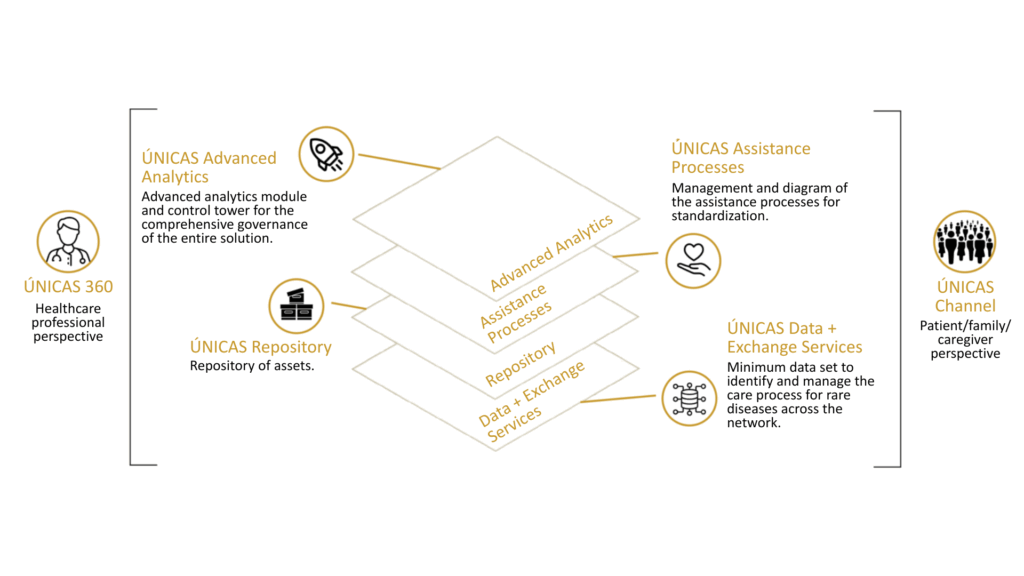
Tools at different layers are developed to provide services to both of these visions, such as: data and exchange services, repository, care processes, and advanced analytics.
On minority diseases
The European Union considers minority diseases those that affect less than 5 in every 10,000 people. It is estimated around 5,000 and 8,000 minority diseases exist worldwide and between 6% and 8% of the world’s population can be affected. Furthermore, many are serious, chronic, disabilities, or potentially deadly. This is why a good diagnosis and treatment are of vital importance.
The current answer to minority diseases from health systems in Spain, specially paediatric diseases, are insufficient for the following reasons:
- Obtaining a diagnosis is a complex and long process.
- The fundamental lack of specific treatments for many minority diseases.
- The difficulty to group patients with similar cases and grant comprehensive care.
- The difficulty to access specialised centres depending on the patient’s geographical origin.
- The lack of health and social devices geared towards chronic cases and palliative care in paediatrics.
- The shortage of capacity resources in the field of minority paediatric pathologies.
