

The Girona Health Region begins to implement the new model of care for critical and semi-critical patients
10 of June of 2025
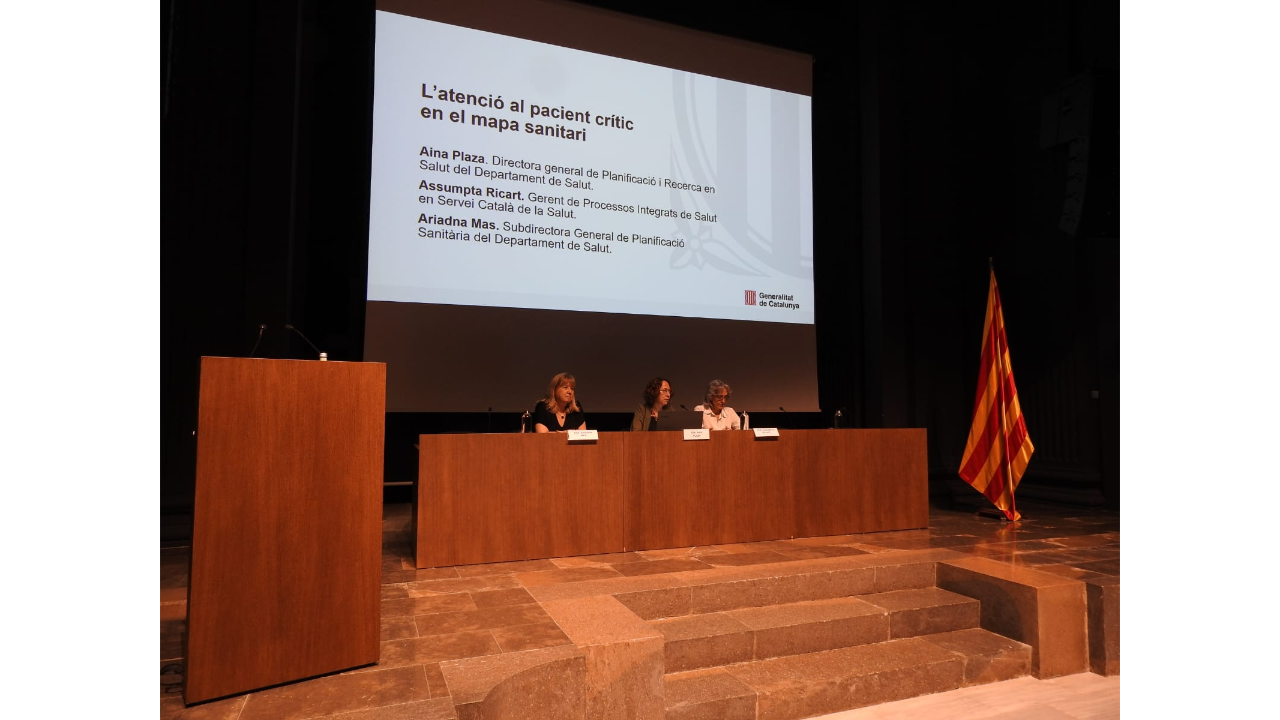
The Girona Health Region has begun implementing a new model of care for critical and semi-critical patients. The goal is to improve the delivery of intensive care services throughout the region by introducing a care model based on digital tools. The project includes a technological upgrade —Critic.CAT— which will facilitate the transfer of information and knowledge among all healthcare system actors involved in the care of critical and semi-critical patients (reference hospitals, regional hospitals, and the EMS). This will support decision-making, improve the efficiency of available resources, and promote equity in the public healthcare system. Critic.CAT and its adaptation to the territory of Girona was presented today, Tuesday 10 June, at the Josep Irla Auditorium in Girona, in an event attended by around 150 people from the sector.
In the Girona Health Region, the first phase of the project, which starts now, will be piloted between Trueta Hospital, the reference centre, and the Palamós Regional Hospital. Once this pilot phase is completed and the results analysed, the model will be implemented across the rest of the region, involving the hospitals of Calella, Figueres, Olot, and Santa Caterina.
The implementation of the new technology in the Girona Region will be accompanied by the creation of new beds for the care of critical and semi-critical patients. Currently, in the area, the Intensive Care Service of Trueta Hospital has 18 critical care beds and 4 semi-critical beds in the same centre, plus 8 critical and 4 semi-critical beds at Santa Caterina Hospital. In addition, there are also critical and semi-critical beds for other specialities, such as cardiology, neurology, neurosurgery, anaesthesia, pulmonology, etc.
More beds for critical and semi-critical patients
With the deployment of the model in the Girona Health Region, the provision of critical and semi-critical beds managed by specialists in intensive care medicine will be improved, as 12 more critical beds will be created at Trueta Hospital, along with a network of 36 semi-critical beds distributed throughout regional hospitals: 12 at Sant Jaume Hospital in Calella, 8 at Figueres Hospital, 8 at Palamós Hospital, 4 at Olot Hospital, and 4 more at Santa Caterina Hospital. Thus, the number of intensive care beds for critical patients will increase from 26 to 38, and general semi-critical beds will increase from 8 to 40. In addition to the necessary structure and equipment, these centres will also be equipped with Critic.CAT technology, which will allow professionals at regional hospitals to care for patients at their own facilities, with continuous remote monitoring by intensivists at Trueta Hospital and the critical care physician at the Health Coordination Centre (CECOS) of SEM, with full assurance.
With this project, coordination between hospitals in Girona will be improved to optimise the management of adult critical and semi-critical patients, care resources will be adjusted to better serve this type of patient based on the needs of the population, and a new care model tailored to this patient profile and the population’s needs will be created and implemented. Furthermore, the implementation will be aligned with the current situation and will serve as a foundation for the upcoming Health Campus, where there will be a single critical care service supporting a network of semi-critical services across the territory.
The new model will make it possible to increase the number of structural beds, reduce the transfer of critical patients outside the Girona Health Region (currently around 60 people per year), improve territorial equity, treat patients closer to their homes and with the resource that best matches their care needs, and improve patient flow between hospitals. In this way, regional hospitals will be able to provide care to semi-critical patients with full guarantees, both in the event that they do not require admission to the ICU, and when the patient is discharged from the Trueta ICU. This way, they will be able to continue their hospital stay at their local facility, under the supervision of the intensivists from Hospital Trueta.
The plan is to start now with the pilot between the Trueta and Palamós hospitals, and continue with the provision of beds and technology to the rest of the regional hospitals, so that by 2027, the model will be fully implemented across the region, coinciding with the expansion of critical care beds at Trueta Hospital. These new critical care beds will be located in the building that will house the expansion of the surgical block and the oncohematology day hospital, currently under construction.
The five axes of technological transformation
The technological deployment is structured around five key pillars. First is the definition of the management
model and action protocols, i.e. defining a procedure to establish mechanisms that facilitate decision-making based on patient needs, available resources, and clinical guidelines and protocols.
Second, having the departmental system for internal, integrated, and comprehensive management of critical care units in SISCAT centres, i.e. the technological platform that will connect all involved actors (health centres and SEM). This system is designed for clinical planning and management, for healthcare use, and for analysis and research. Therefore, the departmental system emphasises offering information on the status of a critical or semi-critical unit in real time, the status and evolution of patients on an individual basis, and offering a view of the historical patient record. This platform will collect all types of clinical information, including medical images and vital signs from sensors and other medical devices.
Third, the departmental system will enable the use of telemedicine; that is, it will allow the integration and visualisation of information across the entire system, and improve coordination with hospitals through a secure and stable technological configuration.
The fourth axis of transformation is the creation of a critical care management centre that will support decision-making for the various professional profiles involved in the care of critical patients.
Lastly, an analysis unit will be created, that is, a system for strategic advising and for the deployment of tools that make it possible to exploit and analyse all collected data for the purposes of research, innovation, evaluation, and planning of services for critical patients.

-
Hospital Trueta will expand with 12 new critical care beds, and a network of 36 beds for semi-critical patients will be created across the hospitals of Calella, Figueres, Olot, Palamós, and Santa Caterina.
-
Critic.CAT is a care model based on digital tools that will support decision-making, improve the efficiency of available resources, and promote equity in the public healthcare system.