

The Department of Social Rights and Inclusion and the TIC Salut Social Foundation are driving the digital transformation of social services in Catalonia

7 of October of 2025
The Department of Social Rights and Inclusion and the TIC Salut Social Foundation are advancing their collaboration to accelerate the digital transformation of Catalonia’s social services system, based on innovative technology. The aim is to drive technological modernisation and improve the coordination of social services, placing the quality of citizen centred care.
This is a transformative initiative with direct added value for improving social services, bringing benefits such as more personalised and accessible care; reduced bureaucracy and duplication between social and healthcare services; greater equity, efficiency and transparency in the management of public resources; and increased technological autonomy for municipalities and third sector professionals.
Strategic objectives and lines of work
The collaboration between the Department of Social Rights and Inclusion and the TIC Salut Social Foundation is formalised through an agreement that sets out different areas of work to finance different projects funded by Next Generation EU funds. The Foundation is responsible for the technological evaluation of 75 projects, focusing on:
-
Supervising the technical control of all projects to ensure efficiency and avoid duplication.
-
Promoting interoperability between social and healthcare information systems, with the support of the Department of Health.
-
Providing technological support to local authorities and third sector organisations, ensuring that digital deployment is homogeneous and sustainable across the territory.
More specifically, the Foundation is evaluating lines 2, 3 and 4, linked to social or healthcare provision.
-
Line 2: aims to finance initiatives that use technology to provide solutions for people in situations of dependency and/or disability, or with social problems arising from mental illness. These solutions should facilitate personal autonomy and enable people to remain in their home environment. In addition, they should foster integrated social and healthcare provision, as well as the participation and involvement of volunteer networks in care and support.
-
Line 3: focuses on technological projects that contribute to improving and transforming social services management models. This line finances investment in technology and information systems that enhance the management of social services and enable the transformation of current intervention models.
-
Line 4: focuses on innovation projects in social services. This line funds pilot initiatives that promote innovative care models in the field of social services, through new initiatives that can be applied across the system, encourage the exchange of knowledge and learning, and drive modernisation processes.
Thus, in 2022 two projects under line 2 were evaluated. In 2023, seven projects from lines 2 and 3. In 2024, thirteen projects from lines 2 and 3. The evaluation of the remaining projects, related to lines 2, 3 and 4, will be carried out during 2025 and 2026, in order to meet the requirements set out in the 2024 agreement.
Areas of action and project deployment
Among the areas of action of the different projects are the following specialities:
-
Home automation applied to residential homes
-
Technology for socio-educational support of people with intellectual disabilities
-
Digital transformation to improve care processes for residents
-
Digitalisation of residential centres
-
Telecare services
-
Development of mobile applications for professionals
-
Technology to combat unwanted loneliness
-
Platforms to optimise the internal processes of organisations
-
Applications for home care
-
Digital transformation of social services
The deployments have been carried out in municipalities, associations, foundations, private companies, residential centres and homes, validating digital solutions that respond to today’s societal challenges and that help to enhance the optimisation and quality of social services.
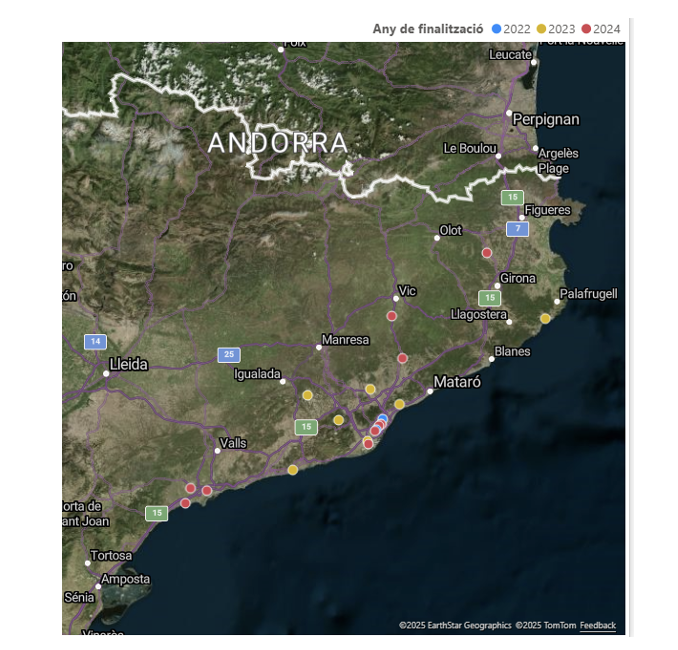
Map of deployment

-
The collaboration is formalised through an agreement that sets out different areas of work to finance a total of 75 projects funded by Next Generation EU funds