

Immersive technology brings benefits to the intervention of Autism Spectrum Disorder
10 of October of 2025
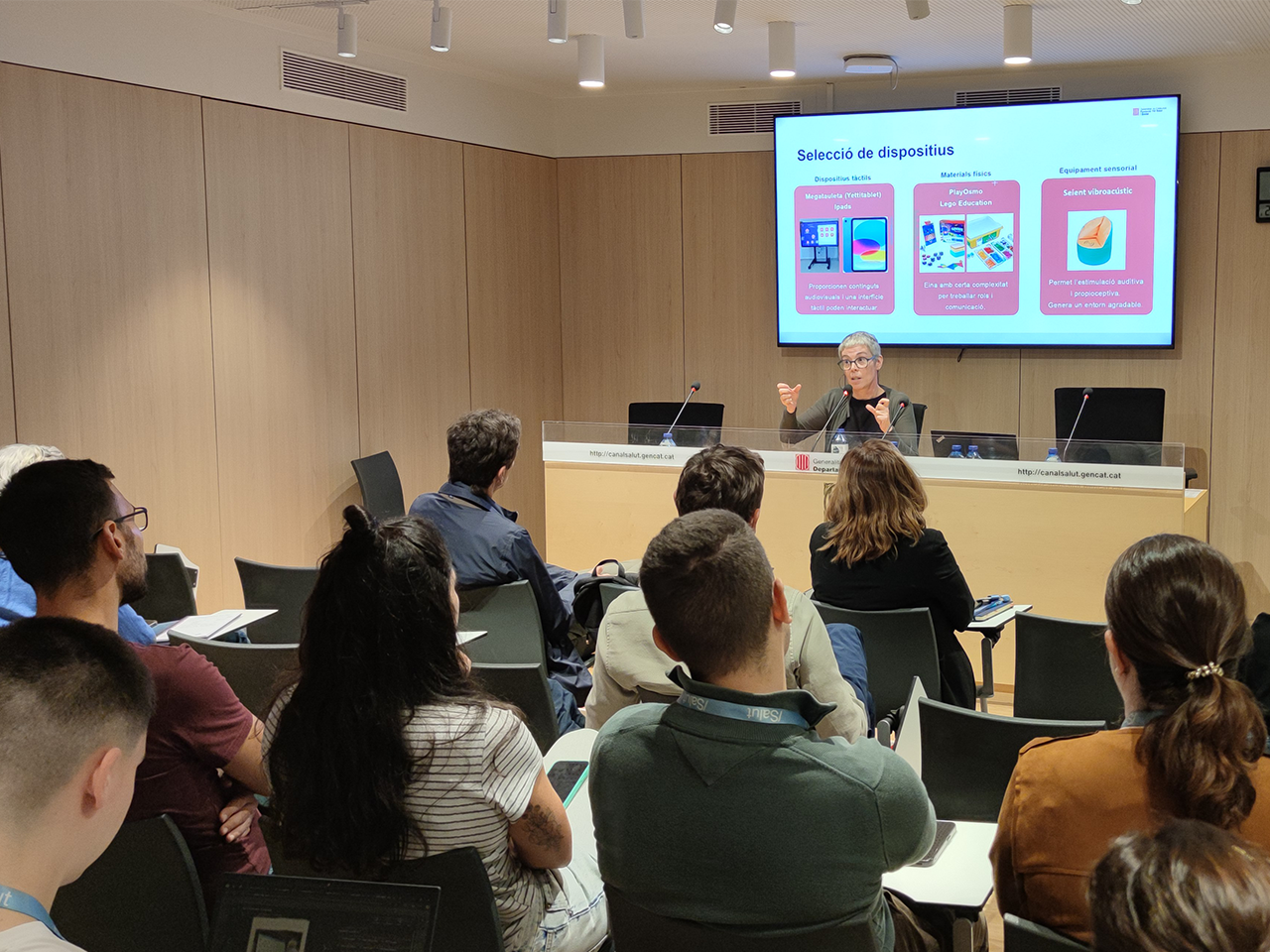
TIC Salut i Social Foundation, Fundació GURU, Fundació Sant Francesc d’Assís and the eHealth Centre of Universitat Oberta de Catalunya (UOC) presented the results report of the Project on the ICT use in the treatment of Autism Spectrum Disorder (ASD). The study has made it possible to identify benefits in the combination of certain devices in immersive technological environments aimed at participants with different degrees of ASD who live in residential centres.
The study’s coordinator and Head of Personalised Digital Care at the TIC Salut i Social Foundation, Núria Abdón, highlights that “the results of the pilot test are positive, as we obtained favourable values in cognitive and social aspects depending on the type of technology used.” Abdón adds that “the study has allowed us to achieve our objective, which was to identify methodologies and care models for people with ASD through ICT.”
The pilot test involved 33 participants with level II or III ASD and intellectual disability – six minors and 27 adults – who were supported by the GURU Foundation and the Sant Francesc d’Assís Foundation. The interventions were carried out individually, in groups, and in collaborative groups, adapted to the participants’ profiles, and focused on the main areas of intervention for this disorder: communication and social interaction, behavioural regulation, and autonomy and self-determination.
Technological immersion room
The TIC Salut i Social Foundation equipped the Autism GURU Foundation with a technological immersion room featuring tablets, a large tablet, a seat with vibroacoustic stimulation, and construction and programming devices. The technology was tested over two months with 19 participants.
As stated in the report, the combination of the vibroacoustic seat and the tablets proved to be the most successful solution due to its adaptability to different types of activity, the possibility of adjusting the level of stimuli each participant receives, and its ease of use.
According to Pat Sánchez, technology coordinator at the Autism GURU Foundation, “the pilot test has allowed us to implement an effective, accessible, comprehensive, and motivating intervention model for children, young people, and adults. We have been able to increase the number of self-determined leisure activities, as well as offer motivating activities to prevent cognitive and motor deterioration.” Given the benefits observed, Sánchez explains that the activities continue to be carried out with all the residents, emphasising that “the use of technology in daily home activities is a consolidated line within the intervention model we offer at the Autism GURU Foundation.”
Immersive virtual environment
The Sant Francesc d’Assís Foundation tested a 360-degree projector that provides an immersive and multisensory experience by combining 3D graphics, sound, videos of real and simulated environments, motion tracking, and visual display devices. This technology was tested over three months with 13 participants.
During this period, progressive improvements were observed in the participants’ cognitive, motor, and social skills, as well as a general fascination with the visual stimuli related to reality.
The Sant Francesc d’Assís Foundation states that “the experience of incorporating an immersive room has represented a qualitative change in the intervention offered at Les Hortènsies Residence, opening up new lines of intervention.”
Methodology
The study’s methodology was designed to facilitate the gradual integration of technology into daily routines, with an emphasis on its transferability to residential and educational settings.
The coordinator of the Research and Project Support Service at the eHealth Centre of the UOC, Noemí Robles, who provided methodological advice in the design and evaluation of the project, says that “care was taken to ensure a balance between scientific rigour and the applicability of the intervention in real environments, so that the implementation of the interventions was not only as well-adapted and beneficial as possible for the people receiving them, but also that the study data provided the highest possible level of evidence.“
About autism
ASD is a neurodevelopmental disorder that manifests during early childhood and accompanies the individual throughout their life. It can appear with varying degrees of severity in the areas of communication and social interaction, as well as restricted interests and repetitive behaviours.
It may also be associated with other disorders and can result in different intellectual levels. According to the Autism Federation of Catalonia, 1 in every 100 people has this disorder, and it is estimated that around 77,000 people in Catalonia are affected.
-
The results report of the pilot test on the use of ICT in the treatment of ASD is now available.