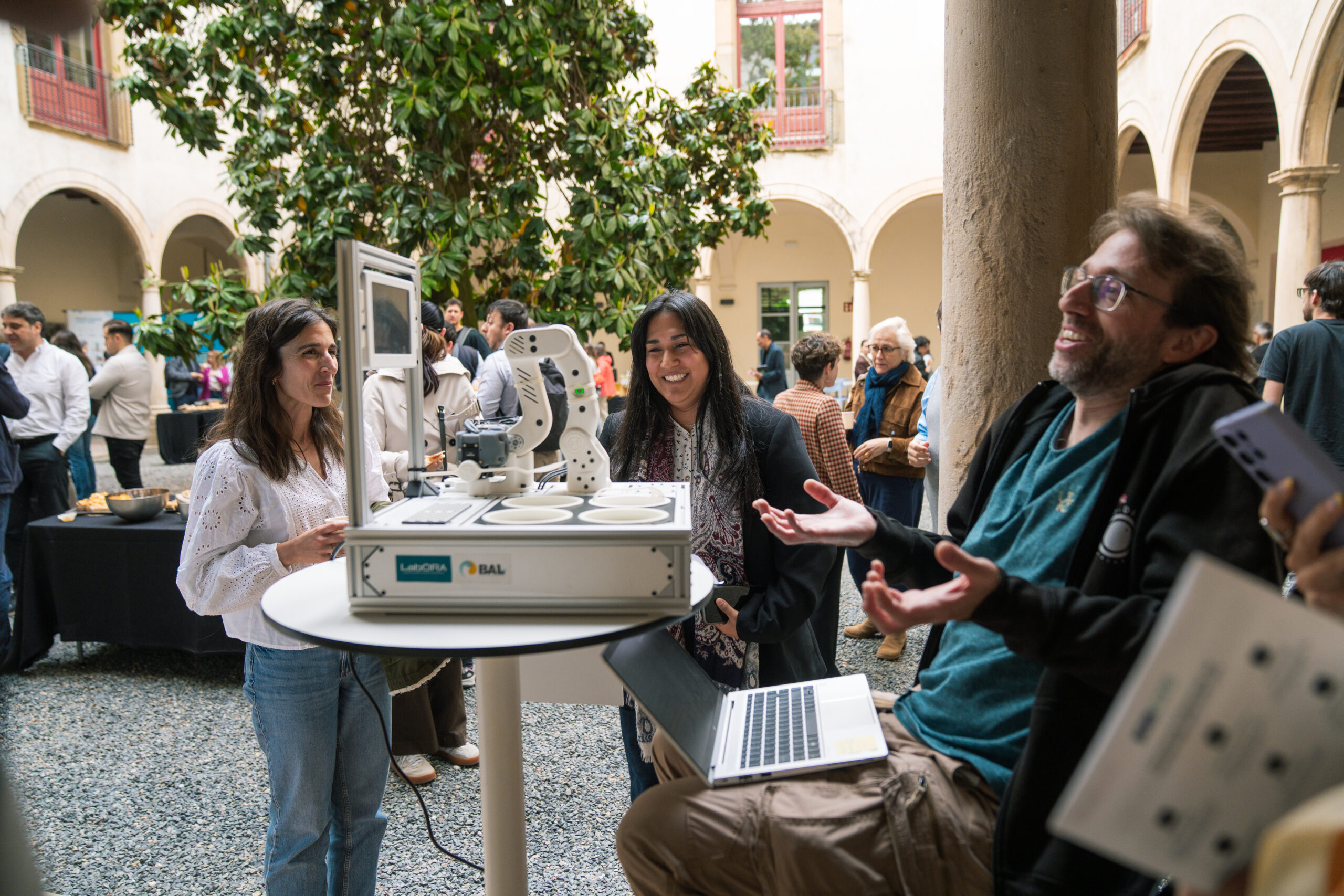
The Government has approved the signing of the “General Protocol of Action for the Development of the Open Assistive Robotics Laboratory (LabORA)” , an open community that connects public administration, industry, innovation, and the care sector to improve quality of life through assistive robotics.
Based at the Institute of Robotics and Industrial Informatics (IRI), LabORA is consolidating its role as a leading hub that brings together public administrations, research centers, companies, and care-sector organizations to improve people’s quality of life while fostering a new strategic economic sector in Catalonia.
The protocol, which outlines the shared commitment and operational guidelines of the signatory parties, will be signed by the organizations promoting the initiative: the Government of Catalonia—through the Department of Business and Labour—Barcelona City Council, CSIC, UPC, Eurecat, i2CAT, PAL Robotics, Saltó Group, Suara Cooperative, the TIC Salut Social Foundation, the Mobile World Capital Barcelona Foundation, and Parc Sanitari Pere Virgili.
Coordinating and Strengthening Catalonia’s Assistive Robotics Ecosystem
The signing of this protocol establishes collaboration guidelines among the participating organizations with the aim of coordinating LabORA’s activities and fostering a strong and innovative ecosystem. The protocol defines joint working criteria and monitoring mechanisms for all parties involved.
The main objectives of LabORA are:
To identify and promote technologies that can be applied to real-world use cases and improve the lives of users and caregivers.
To become the leading center for the development and evaluation of assistive robotics.
To create a meeting point for the innovation ecosystem, industry, the care sector, and public administrations.
To strengthen the business ecosystem linked to assistive robotics solutions.
Areas of Action Covered by the Protocol
The document establishes several shared lines of work, including:
Outreach: Organizing awareness and dissemination activities on the impact of assistive robotics in social and business contexts.Ecosystem Development: Promoting a physical and virtual contact point that connects stakeholders across the sector.Innovation: Generating high-value projects to strengthen strategic sectors, including the third sector.Internationalization: Promoting Catalonia as an international benchmark hub.Ecosystem Activation: Encouraging the adoption of assistive robotics and stimulating innovation.Ethics: Promoting an approach aligned with European principles for trustworthy AI.
Robotics at the Service of People
Assistive robotics is a rapidly growing field that will transform the way people live and receive support in their daily activities. These technologies will enable people who require assistance to maintain their independence at home for longer while providing essential tools for care professionals, allowing them to devote more time to personalized, high-quality care.
This field presents new scientific and technological challenges: assistive robots must be safe, adaptable, customizable, compatible with human environments, and capable of handling deformable materials. At the same time, they open the door to a new economy based on high-value-added products and services.
In this context, LabORA is an initiative designed to foster an innovation ecosystem that will provide Catalonia with technological sovereignty in the field of assistive robotics, with the goal of developing new sustainable care models. It proposes a people-centered model focused on improving well-being and generating systemic impact, delivering tangible outcomes such as functional prototypes, transferable knowledge, and open tools that can be scaled to other care environments.
The initiative is part of the Catalonia AI Strategy 2030 ,