

Catalonia showcases its strategy for healthcare AI at an international NHS event
5 of November of 2025
As the United Kingdom prepares to launch its NHS AI strategic roadmap later this autumn, the AI in the NHS 2025 conference gathered international experts to explore what the UK can learn from global experience in artificial intelligence (AI) for health. Among the participants, Joan Guanyabens, Director of the TIC Salut Social Foundation, presented Catalonia’s strategy for healthcare AI, outlining the achievements, priorities, and lessons learned since the conception of the Health AI Programme, back in 2019. The event was organised by The Health Foundation and streamed online on the 14th of October.
Global lessons in AI for healthcare
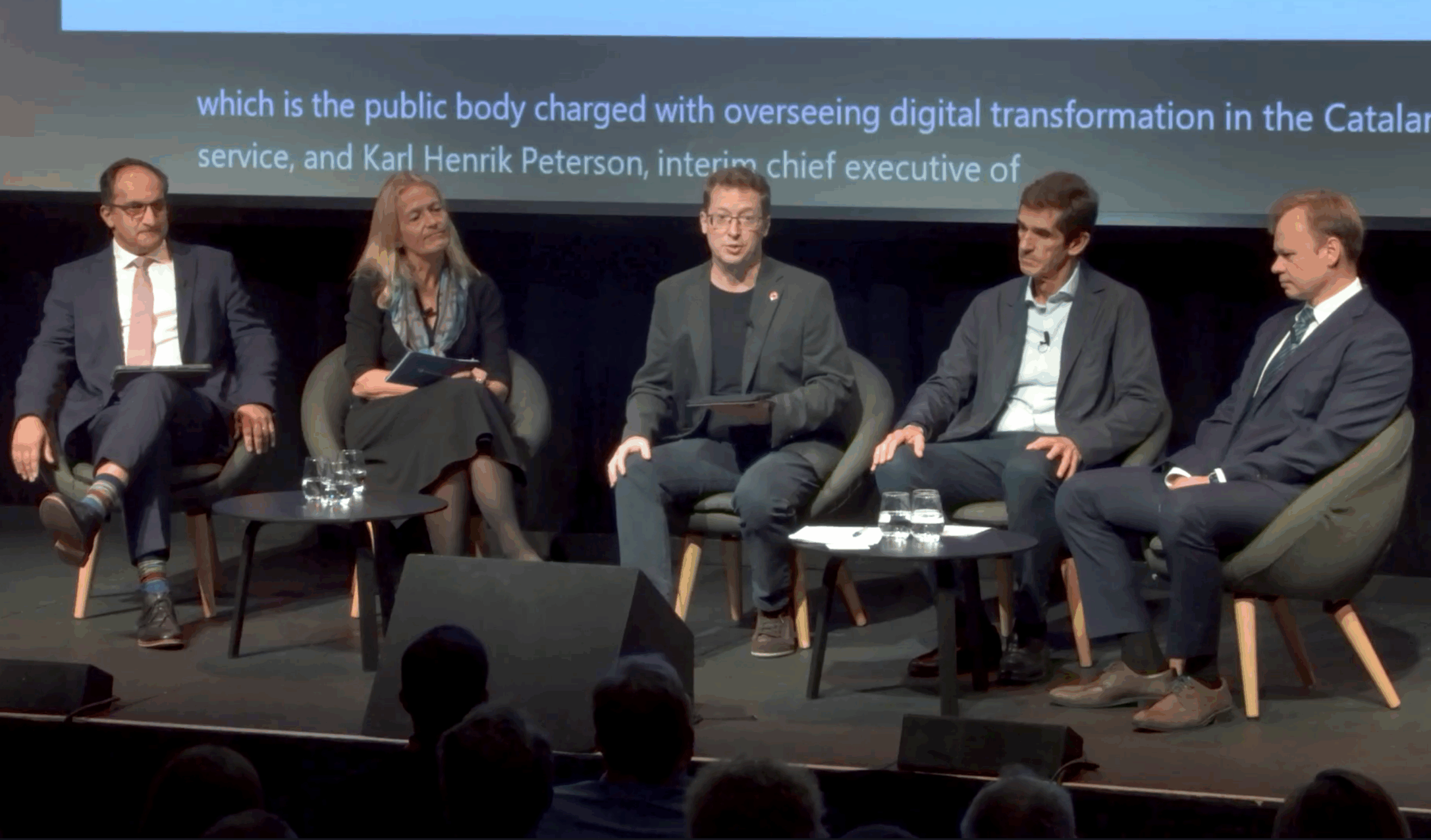
Representing Catalonia, Guanyabens participated in the panel session ‘Global lessons in AI for healthcare: innovations, challenges, and the path forward’, together with Alec Price-Forbes, National Chief Clinical Information Officer at NHS England, Hilde Lovett, Senior Advisor at the Norwegian Directorate of Health, and Karl-Henrik Peterson, Interim CEO of the Estonian Health Insurance Fund.
The Director of TIC Salut i Social Foundation outlined the Catalonia pragmatic approach to AI, grounded in a high level of digitalisation and data quality, skilled professionals and cutting-edge infrastructures to hold the data processing. “The goal is simple yet essential: to do more with fewer resources, while demand continues to grow and resources remain limited”, stated Guanyabens.
After that, he gave a quick overview of the strategy and main activities performed under the umbrella of the Health AI Programme in Catalonia. This includes the launch of six challenges related with diabetic retinopathy, stroke, dermatology, chest X-Ray, a medication chatbot, and voice assistant; the development of several best practices guidelines, and the creation of the AI Obervatory in Health, among other initiatives.
Guanyabens also annouced Catalonia’s next steps in this field: strengthening AI governance, monitoring European regulation with the possible creation of a Catalan notified body, supporting the European Health Data Space using openEHR standards, registering and monitoring all algorithms through the AI Observatory, and developing sustainable business models that protect data sovereignty and usage rights.
Finally, asked about some advice to give if he could go back for a year, he stressed the importance of involving clinicians from the very beginning of AI solutions, to be aware of all the difficulties of the path ahead.
“The greatest innovation we have right now is not just AI, is human intelligence”
Alec Price-Forbes highlighted several challenges currently facing the NHS, many of which are shared by Catalonia and other regions. These include growing demand for healthcare services and an ageing population, with healthy life expectancy now falling notably behind overall life expectancy. As a result, more people are living longer with chronic, multiple conditions. At the same time, the health system continues to face constrained resources, both in workforce and funding, alongside rising expectations from patients and healthcare professionals.
Reflecting on this context, Price-Forbes pointed out that the success of AI in healthcare does not depend on the technology itself, as it requires digital foundations, the right governance and cultural change. “Technology doesn’t heal; people do. And the greatest innovation we have right now is not just AI, is human intelligence. It’s about empathy, passion and embracing new ways of working and change, what it means providing high quality services to transforms people’s lives”.
AI experiences in Norway and Estonia
Representing Norway, Hilde Lovett explained that the country began working with predictive AI in a hospital in 2019. Its use was quickly expanded nationwide through a flexible and dynamic action plan with the goal to “frame and provide clear guidance on how to implement AI safely and effectively within healthcare services”, said Lovett.
Up to date, AI supports not only administrative management but also radiology and other clinical areas, including mammography and diabetic retinopathy. For instance, patients now arriving at emergency departments with a suspected fracture have an AI system which assesses the likelihood of a break. If the probability is very low, the patient can safely return home. A radiologist reviews the image within 24 hours to ensure accuracy and maintain quality of care.
Finally, Karl-Henrik Peterson highlighted that Estonia’s strong digital foundations stem from having built its systems from scratch. He noted that the entire country recognises the need to deploy AI to secure its future: “Estonian economy in a whole is all in deploying AI, there’s no other way to keep the present level of services and the economy.” He also warned of major demographic challenges ahead, with the population expected to halve by the end of the century and a third of primary care clinicians set to retire within five years. As a practical example, he pointed to AI transcription tools already in use, which help doctors save around four minutes per 20-minute consultation.
The other session of the AI in the NHS 2025 conference explored how to ensure that AI technologies in healthcare are safe, effective and rigorously evaluated. Speakers from Newton’s Tree, the Imperial College Healthcare Trust, Moorfields Eye Hospital and THIS Institute discussed the practical challenges of scaling AI across the NHS.
For more information, all the interventions are available on the Health Foundation webpage.
-
The Director of the TIC Salut Social Foundation presented Catalonia’s healthcare AI strategy, sharing milestones, priorities, and lessons learned since the Health AI Programme began.