

HUAV and CUAP Lleida use a pioneering artificial intelligence system to optimise emergencies from patients' homes
13 of December of 2024
The Emergency Service of the Arnau de Vilanova University Hospital (HUAV), together with the Lleida Primary Care Emergency Centre (CUAP), have implemented a system based on artificial intelligence that indicates to patients which of the two emergency centres is the most suitable for their treatment, based on the severity of their symptoms. The tool, which has now been published on the hospital website, is a pioneer in Catalonia. It was tested last winter in the reverse shunt procedure with very positive results and aims to optimise healthcare resources and improve the patient experience.
With the reverse referral procedure, less or non-serious cases that come to hospital emergency services can be referred to the CUAP so that they receive more resolute care in the optimal time and, at the same time, contribute to alleviating hospital emergency services.
The head of the Emergency Service of the HUAV, territorial clinical director of the Emergency Department of Lleida and researcher at the eHealth Centre of the UOC, Oriol Yuguero, explains that “the optimal use of all emergency care resources is very important for the sustainability of the system. What’s more, in the public health network we have excellent quality care resources and we must have hospital services available to attend those patients who are serious or in potential life-risk situation.”
In this sense, Mr. Yuguero points out, “the inclusion of artificial intelligence in reverse derivation has meant an evident improvement in the procedure and has helped to empower nursing professionals, who are the ones who manage the reverse referral. And now we are going further, making it easier for patients, from their home, to carry out a self-assessment and know which resource they are recommended to go to, either the CUAP or the hospital.”
As for the director of CUAP Lleida, Sílvia Solís, she is equally satisfied with the new system and points out that “the implementation of this artificial intelligence tool represents a step forward in the way we manage emergencies in the region. The system not only speeds up care, but also improves the user experience, who positively value the speed and resolution that we offer them from our centre.”
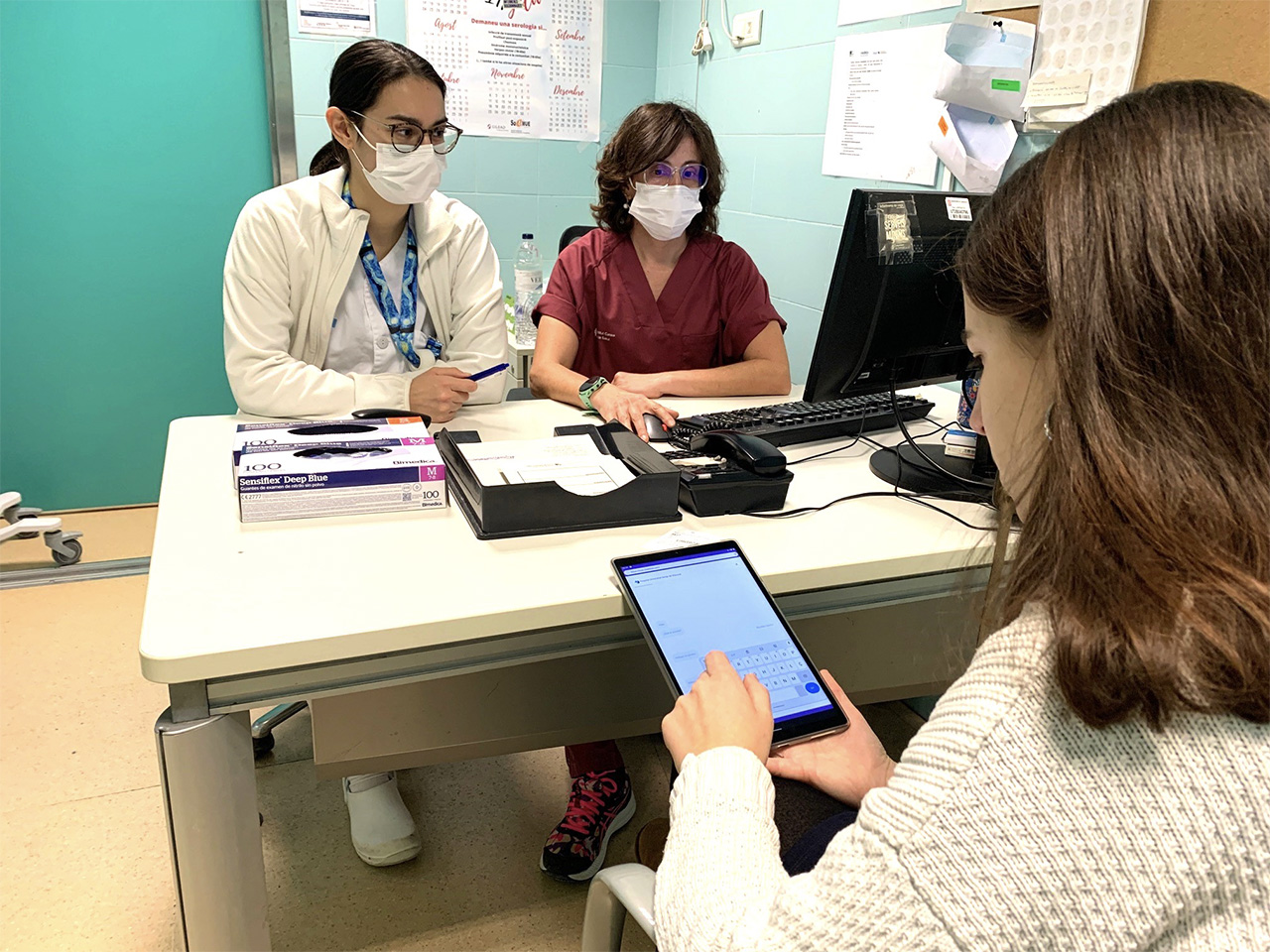
The symptom assessment tool has been available since this December on the HUAV website and in the centre’s emergency rooms where, at the time of triage, patients included in the circuit receive a tablet to answer a series of questions. Once this evaluation is made, the application recommends that they stay in the hospital or go to the CUAP, located 10 minutes away on foot. Those who decide to go to CUAP, when they arrive, receive faster attention.
Results of the pilot study
The pilot test of the new system was conducted by the HUAV Emergency Service, with the collaboration of Mediktor, the TIC Salut Social Foundation and the eHealth Centre of the Open University of Catalonia (UOC), which evaluated the results.
From 6 November 2023 to 1 March 2024, the HUAV Emergency Service treated a total of 35,531 patients, 6,762 of whom received a triage level of IV or V, that is, of low severity. Of these, following certain criteria, 6.8% (462) were included in the reverse derivation test, although this was ultimately applied to 427 patients.
After the evaluation, in 43.6% of cases the tool recommended going to the CUAP, compared to 54.6%, who were suggested to remain in the hospital. Of the patients who received the recommendation to go to the CUAP, 91% left the hospital. 73% arrived at the CUAP, while 17% decided to go home without receiving any type of care. 95% of patients who were treated at the CUAP after referral from the hospital were discharged at the end of the consultation and 85% did not come in again during the following 15 days.
On the other hand, 78.3% of patients to whom the tool recommended remaining in the hospital after being evaluated decided to leave anyway due to the low severity of their symptoms, either going to the CUAP (59%) or directly home (19.3%). None of the patients who remained at the HUAV after the recommendation required hospitalisation.
According to the director of the TIC Salut Social Foundation, Joan Guanyabens, “the incorporation of artificial intelligence for the triage of emergency patients has proven to be an effective support tool to optimise case management and show patients the available alternatives for urgent care, like primary care centres”.
Improving accessibility and optimising resources
Posting the tool on the website has further improved accessibility and the optimisation of resources, as users can describe their symptoms from home, simply and intuitively, in less than three minutes. Once the assessment is complete, they receive the recommendation and a downloadable document with all the necessary information with a QR code that they must show when entering the Emergency Service or CUAP, to expedite their care.
With the implementation of the artificial intelligence tool, the HUAV and CUAP Lleida, managed by the Catalan Health Institute, are working to decongest emergency services, improve waiting times and ensure that each patient receives the right care in the right place. This project reinforces the hospital’s commitment to continuous improvement of service quality and the efficient use of healthcare resources.
-
Nota de premsa
-
173.2 Kb

-

-
-
It was tested last winter in the reverse shunt procedure with very positive results and aims to optimise healthcare resources and improve the patient experience.