

In Catalonia there are 419 companies dedicated to digital health that already have a turnover of 652 million euros
22 of May of 2026
The digital health ecosystem in Catalonia has 419 companies, 9% more than a year ago, with an aggregate turnover of 652 million euros (+3%) and employing 5,326 people (+1%). These are the main conclusions of the study that examines the sector, “Digital Health in Catalonia”, prepared by ACCIÓ – the agency for business growth of the Department of Business and Employment – in collaboration with the Barcelona Health Hub and the Fundació TIC Salut i Social (Department of Health).
Within the framework of the study, digital health includes the set of tools and services that use ICT to support and improve all stages of healthcare, from prevention and diagnosis to treatment, monitoring and management of health conditions.
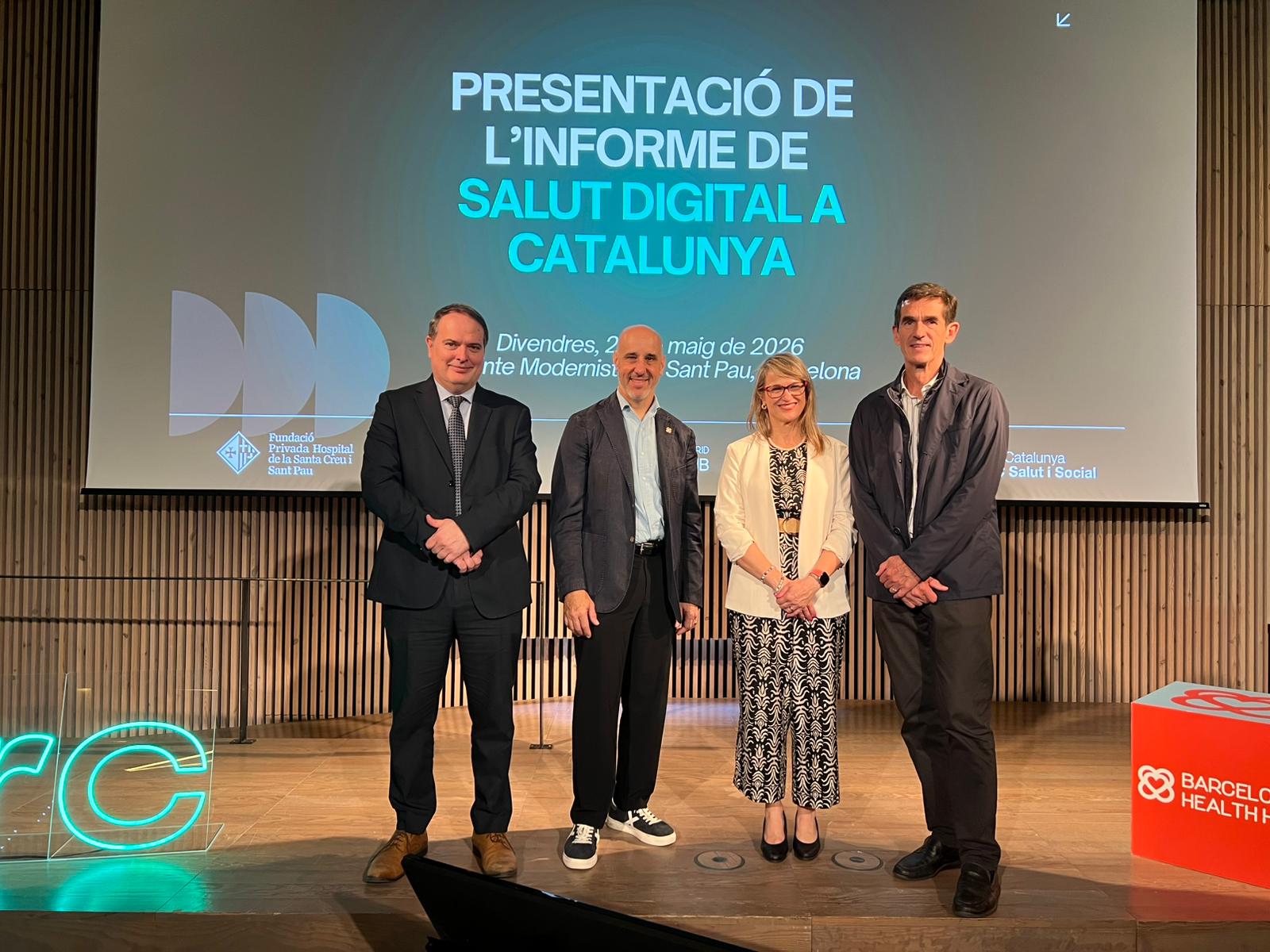
The executive director of ACCIÓ, Joan Romero, led the presentation of the study, together with the president of the Barcelona Health Hub, Cristian Pascual, and the director of the TIC Salut i Social Foundation, Joan Guanyabens. The event was held this Friday at the Recinte Modernista de Sant Pau as a preview of the Health Revolution Congress that the Barcelona Health Hub is organizing next week in Barcelona.
Romero highlighted that “the health sector is one of the most important in the Catalan economy and the conclusions of this study show that it is also one of the sectors that is undergoing the most transformation with the digitalization of its processes”. “It is very good news that this sector is growing and that it encompasses both consolidated companies and startups that, at the same time, join forces with an entire network formed by research centers, universities and other agents in the environment that contribute to transferring research and all the knowledge they have into real, tangible solutions that benefit not only the Catalan business fabric as a whole, but our entire society”, he stressed.
For his part, the president of the Barcelona & Madrid Health Hub, Cristian Pascual, explained that “the continuity of this report and the sustained growth of the ecosystem demonstrate the power of digital health in Catalonia. We have a unique opportunity to lead digital health on a global scale and we cannot miss it. It is essential that governments invest in this sector: not only to guarantee its economic sustainability, but also to preserve the well-being of professionals and all citizens.”
In turn, the director of the TIC Salut i Social Foundation, Joan Guanyabens, highlighted that “in a context marked by the emergence of artificial intelligence in the field of digital health, it is essential to ensure the responsible, safe and ethical use of these technologies. We work to identify and anticipate these trends and, for this reason, we have a duty to validate AI solutions using data from the Health System of Catalonia, ensuring their quality, compliance with current regulations and the generation of trust among citizens and healthcare professionals. They are the main beneficiaries of these increasingly interoperable tools, which are integrated with other data spaces beyond health”.
An innovative ecosystem on the rise
The majority of companies dedicated to digital health in Catalonia are SMEs (92% of the total) and 29% have a turnover of more than one million euros. It is a dynamic and growing sector, since 63% are less than 10 years old and 55% are startups. The study also examines the activity of these companies from a business point of view. Thus, the majority (38%) are dedicated to the development of clinical tools, followed by the business segment of digital therapies (26%) and wellness and health services (15%).
It is also a sector closely linked to innovation and new technologies. In this sense, the document highlights the growth of companies that develop artificial intelligence solutions applied to health, which now account for 65% of the total, up from 41.5% a year ago. The main applications of the use of artificial intelligence in digital health include the development of clinical and diagnostic tools, as well as support for medical decision-making or digital therapies, among others.
Beyond artificial intelligence, the rest of the companies in the sector also develop innovations resulting from the incorporation and hybridization with technologies such as cybersecurity, key to the processing of medical data, immersive technologies, robotics, telemedicine or sensors.
In this sense, the report includes a survey of Catalan health centers in which 100% foresee an increase in the implementation of digital health solutions in their centers in the next three years. These solutions will mainly include video consultations, the integration of clinical data or surgical robotics. By areas within healthcare centers, primary care, imaging diagnostics and chronicity are those that are expected to have the greatest impact from these new digital health solutions.
The document also highlights the importance of the richness of the ecosystem of agents within the field of digital health in Catalonia, which includes hospital research institutes, reference research centers, clusters, associations, accelerators, networks and public administration entities.
Health in Catalonia, an internationalized sector that attracts investment
Digital health also has an international component: 14% of the companies identified in the study are exporters, while 12% are subsidiaries of foreign companies established in Catalonia. In addition, the document includes data from the latest edition of the Tech Hubs Overview, which is prepared by ACCIÓ, Mobile World Capital and Barcelona City Council to x-ray the technological hubs of foreign companies established in Catalonia. According to this report, 10% of these centers are dedicated to the health sector and have generated 1,392 new jobs.
On the other hand, the study also highlights that Catalonia is the fourth region in the world and the first in Europe in the number of foreign investment projects attracted in the last five years (2021-2025). Thus, with 23 projects that have raised an investment volume of 997.4 million euros and have generated 1,965 new jobs, Catalonia leads the technological investments in this sector in Spain. Recently announced projects such as that of AstraZeneca, which plans to expand its R&D center in Barcelona and invest 1,300 million euros with the support of ACCIÓ, highlight this good positioning.
Regarding the investment in venture capital attracted by Catalan startups in the field of health, in 2025 this sector has practically doubled the records of the previous year to 351 million euros. In this way, it is in first place in the investment by sector attracted by startups in Catalonia. In this sense, Barcelona ranks as the third city in the European Union in attracting public and private funding for digital health startups in the last five years (2021-2025).
A global recipe
The study also analyses the situation of digital health on an international scale. Thus, it is highlighted that in 2026 the global digital health market will exceed 177 billion dollars and that a growth of 5.4% year-on-year is expected until 2030. This growth is closely linked to factors such as the increase in public spending on health and the general aging of the population, the greater demand for digital solutions and telemedicine, the collection of digitized patient data or health models aimed at prevention and prediction. The United States leads the world in digital health turnover, followed by China and Japan. Among the European countries, the United Kingdom, Germany, Italy and France stand out.
The Health Revolution Congress, a showcase for the sector
Next week, on May 27th and 28th, Barcelona will host a new edition of the Health Revolution Congress, organized by the Barcelona Health Hub and which is becoming the main event in Europe in the field of digital health. This year, the fourth edition of the congress is being held, where the participation of more than 3,500 attendees is expected, including healthcare professionals, startups, investors and institutions from all over the world.
In addition to the public presentation of this study on digital health in Catalonia, ACCIÓ will organize a new edition of the Open Innovation Challenge, a set of meetings where fifteen large companies and hospitals such as Suara, DKV, Werfen, Reig Jofre, Althaia or Roca Group, among others, pose technological challenges related to different areas such as AI applied to health, telemedicine or bioinformatics. It is expected that more than 200 meetings will be held.
In parallel, Startups to Funding will also be held, which aims to connect startups in the field of digital health with potential investors in 10-minute meetings. Thirty investors will participate (such as CRB Digital Health, Montana, Inveready or Capital Cell, among others) and more than 40 startups that plan to hold more than 200 meetings.
Finally, during the Health Revolution Congress ACCIÓ will also organize the Tech Meetings within the framework of the Digital Innovation Hub of Catalonia (DIH4CAT). These meetings allow DIH4CAT technological experts to connect with companies that want to promote their innovation projects with the incorporation of advanced digital technologies. Through 20-minute bilateral meetings, participating companies will have the opportunity to identify technologies with the potential to improve products, services or processes, and explore opportunities with centers such as Eurecat, Leitat, i2CAT, the Computer Vision Center or ICFO.
-
The report 'Digital Health in Catalonia', prepared by ACCIÓ in collaboration with the Barcelona Health Hub and the TIC Salut i Social Foundation, confirms the potential and consolidation of the sector in the country.