

"The Càtedra TIC Salut i Social offers an environment very close to the reality of the health system, and this is especially valuable for a PhD student"
8 of June of 2026
We spoke with Dr. Guillem Hernández, a researcher with the eXiT group (Control Engineering and Intelligent Systems) at the Institute of Informatics and Applications of the University of Girona and also with the Innovation, Health Economics and Digital Transformation group at the Germans Trias i Pujol Research Institute, about his doctoral thesis focused on artificial intelligence (AI) methods to support healthcare decision-making based on longitudinal data. His research was co-supervised by the Càtedra TIC Salut i Social at UVic-UCC.
Can you explain what your thesis consisted of?
My thesis has focused on developing AI methods to help the healthcare system better anticipate patients’ needs and make more informed decisions. I have worked with real health data collected over time to build models capable of predicting healthcare demand, identifying relevant relationships between diagnoses, and estimating an individual patient’s risk of disease progression.
The central idea has not only been to create accurate models, but also to develop tools that are interpretable, reliable, and useful for healthcare professionals. In this sense, the thesis combines AI, causal reasoning, and clinical data to advance toward more preventive, personalized, and efficient medicine.
In short, the work aims to demonstrate how AI can transform large volumes of healthcare data into actionable knowledge to better plan resources, detect risks earlier, and support improved patient care.
What use can the results of your research have for the health system?
The results of my research can help the healthcare system move from a more reactive model to a more anticipatory, preventative, and efficient one. On the one hand, the models developed can be used to predict the evolution of healthcare demand and, therefore, help to better plan professionals, schedules, resources, and services. This is especially relevant in primary care, where anticipating demand peaks can contribute to reducing pressure on healthcare services, improving organization, and better adapting resources to the real needs of the population. In fact, this line of research is already being translated into a practical application: we are currently developing an AI-based system to predict the evolution of demand across all primary care services in Catalonia. The goal is for these models not to remain solely in the academic sphere, but to become useful tools for the planning and management of the healthcare system.
For its part, the thesis provides tools to better understand patient evolution, identifying relationships between diagnoses and estimating individual risks. This can facilitate earlier detection of vulnerable patients and help professionals prioritize interventions.
Finally, a key point is that the models aim to be interpretable, not just predictive. This is essential for AI to be integrated into clinical practice as a reliable, understandable support tool geared towards improving decision-making and the use of healthcare resources.
You developed your thesis in a constantly evolving field that, especially in the health sector, has been having a major impact in recent years. What has that experience been like?
It has been a very intense, demanding, and at the same time, very enriching experience. Working in AI applied to healthcare means navigating a field where technology advances very rapidly, but where every decision must make clinical, ethical, and practical sense.
During my doctoral studies, I learned that it is not enough to develop models that work well on paper: they must be useful, interpretable, and designed to fit the reality of the healthcare system. This balance between research, technology, and real-world impact has probably been one of the greatest lessons of the process.
It has also been a period of personal growth. A doctorate has moments of uncertainty, frustration, and a lot of unseen work, but also very rewarding moments, especially when you see that what you are developing can have a real-world application to improve people’s health.
I also want to take this opportunity to thank my doctoral advisors, all the people who have supported me from the clinical and academic fields, and the research teams with whom I have shared this journey. I also want to thank my family and loved ones for their constant support throughout this entire process. And especially to all those who understand AI not only as a threat or a source of uncertainty, but as a technology with enormous transformative potential. A tool that, if developed with rigor, responsibility, and a human touch, can help improve the healthcare system and, above all, people’s lives.
Finally, what would you highlight about the support and environment offered by the Càtedra TIC Salut i Social to doctoral students?
I would especially highlight that the Càtedra TIC Salut i Social offers an environment very closely aligned with the realities of the healthcare system, which is particularly valuable for a doctoral student. Writing a thesis in this field is not just about developing technology, but about understanding the real needs of professionals, patients, and institutions. In this sense, the Càtedra helps connect research with practical application, facilitating contact with projects, experts, and real challenges in the sector.
I would also emphasize the human and professional support. Feeling that you are part of an ecosystem that fosters innovation, but also understands the complexity of the healthcare and social system, greatly enhances the doctoral process. For me, this environment has been key in guiding my research toward results that go beyond the academic realm and have a real impact on the digital transformation of the healthcare system.
Scientific articles related to the study:
This thesis has been presented as a compilation of three scientific articles, each of which addresses a different need or limitation of the healthcare system, but all with a common thread: the use of AI and causal reasoning to improve decision-making:
- Hernández Guillamet, G. , López Seguí, F., Vidal-Alaball, J., López, B. (2023). CauRuler: Causal irredundant association rule miner for complex patient trajectory modelling. In Computers in Biology and Medicine (Vol. 155, p. 106636). Elsevier BV. [JCR IF 7.0 (2023): , Q1]
- Hernández Guillamet, G. , López Seguí, F., Vidal-Alaball, J., López, B. (2025). CTBN-PH: A Continuous-Time Bayesian Network for Individualised Diagnostic Risk Prediction. In Computers in Biology and Medicine (Vol. 197, p. 111069). Elsevier BV. [JCR IF 6.3 (2024): , Q1]
- Hernández Guillamet, G. , López Seguí, F., Vidal-Alaball, J., López, B. (2025). CCLR-DL: A novel statistics and deep learning hybrid method for feature selection and forecasting healthcare demand. In Computer Methods and Programs in Biomedicine (Vol. 272, p. 109057). Elsevier BV. [JCR IF 4.8 (2024): , Q1]
-
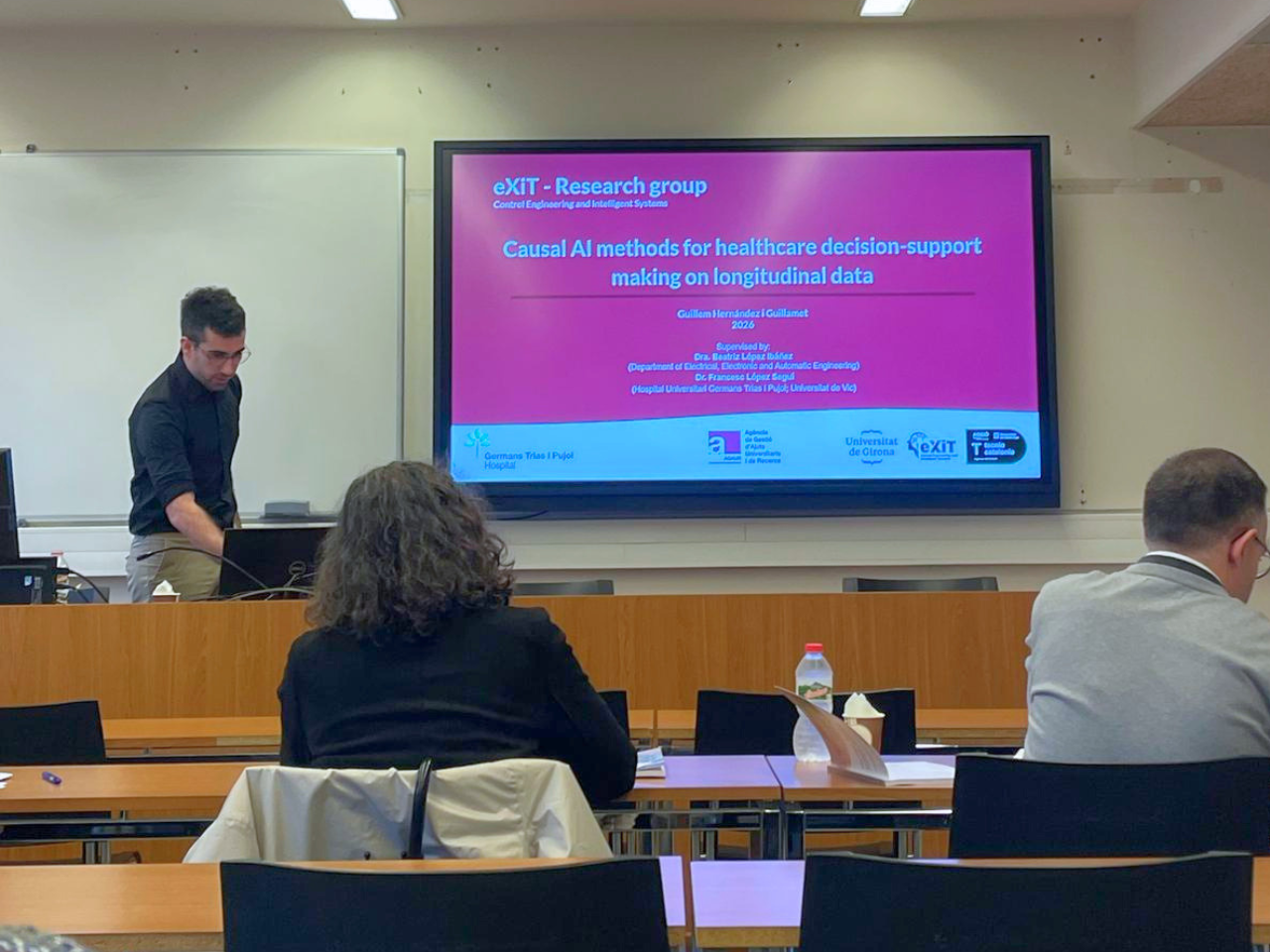
Dr. Guillem Hernández defended his thesis focused on developing artificial intelligence methods to help the healthcare system better anticipate patients' needs and make more informed decisions.