

The deployment of the new model of care for critical and semi-critical patients in the Girona Health Region begins
12 of June of 2026
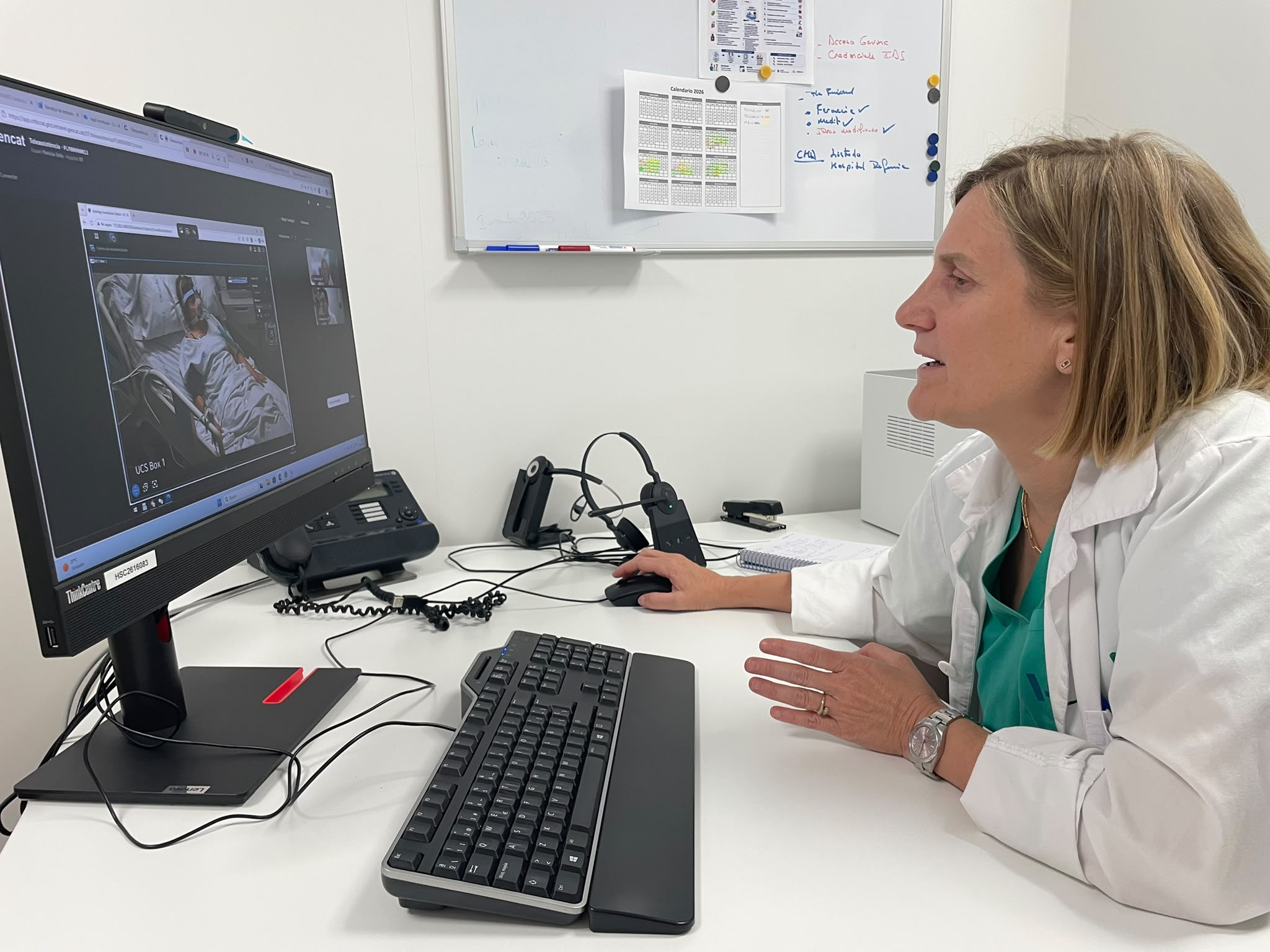
This June, the Health Region of Girona has begun the deployment of the new model of care for critical and semi-critical patients whose objective is to improve the provision of intensive care services throughout the territory with a care model based on the coordination and collaboration of professionals from different hospitals with the support of digital tools.
This deployment has begun with the launch of the new Semicritical Care Unit (UCS) at Palamós Hospital, which has 8 semicritical beds. The UCS is aimed at the care of patients of certain complexity who require semi-intensive vigilance and monitoring with a real-time connection with the Territorial Unit of the critical patient of the Health Region of Girona, formed by the UCI Hospital Universitario Doctor Josep Trueta – Hospital de Santa Caterina and the Unit of Critical Cardiovascular del Trueta. Once the first phase of implementation of the model in Palamós has been completed, and once the results have been analyzed, the project will continue to be rolled out in the rest of the Girona Health Region.
The new unit in Palamós operates 24 hours a day, 365 days a year, with a reinforced staff of healthcare professionals who have completed their training and education to care for this type of patient. Likewise, these patients will have the support of the specialists of the Trueta and Santa Caterina hospitals, through a new technological platform, within the framework of the Critic.CAT project, at the level of Catalonia. This tool facilitates the transmission of clinical information in real time between the centers involved and contributes to improving decision-making, efficiency in the use of resources and territorial equity in the care of general critical and semi-critical patients and with cardiac pathology in the Region of Girona.
The manager of the Girona Health Region, Jaume Heredia, has stated that “the implementation of the model also makes it possible to reduce unnecessary transfers, improve coordination between hospitals and guarantee care closer to the patient’s home, while maintaining the highest standards of quality and care security“. These have also been aspects that have been valued by the Integrated Health Services manager of Baix Empordà, Xavier Pérez, who has highlighted that the project allows “improving care for patients with complex pathology, providing closer and quality care with the support of the intensive care unit of the reference hospital“.
The UCS responds both to patients who do not require admission to a critical care unit, and to those who continue to be admitted after discharge from the Trueta-Santa Caterina ICU or the Trueta Cardiovascular Critical Care Unit, ensuring continuity of care in the local hospital with specialized support.
The project is possible thanks to the implementation of the technological platform, which facilitates the transfer of information and knowledge to all professionals involved in the care of critical and semi-critical patients (referral hospital, regional hospital and SEM).
Advance in deployment last summer
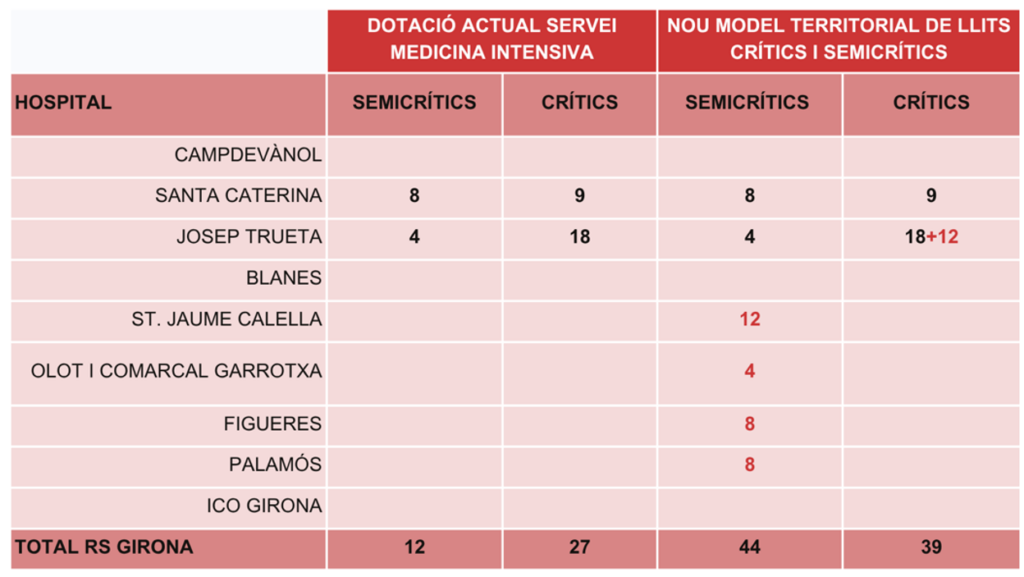
The forecast is to continue with the commissioning of the semi-critical care units at the Hospital de Figueres, with 8 beds, and the Hospital de Olot y Comarcal de la Garrotxa, with 4 beds, after the summer. Later, coinciding with the reform and expansion of Hospital Sant Jaume de Calella, a unit with capacity for 12 beds for semi-critical patients will also be created. These centers, in addition to having the necessary structure and equipment, will also be equipped with technology, which will allow the professionals of the regional hospitals to attend to patients in their centers, with remote and continuous monitoring by the intensivists of the Trueta-Santa Caterina Hospital and with full guarantee.
As for the beds for critical patients, their expansion is also planned, with another 12 beds that will be located in the new building that has been built at the Trueta Hospital. This expansion will connect with the current ICU and will be adapted during 2027.
In this way, with the deployment of the model, from the Girona Health Region, which has promoted the project, the provision of critical and semi-critical beds managed by specialists in intensive care medicine will be improved, as another 12 critical beds will be created at the Trueta Hospital and a network of 44 semi-critical beds distributed everywhere. Thus, once the deployment is complete, the Health Region will have gone from having 27 intensive care beds for critical patients to 39, and from 12 general semi-critical beds to 44. In addition, there are also critical and semi-critical beds for other specialties, such as pneumology, etc.
Great coordination work
For the implementation of the new model, the work of coordination between the professionals involved in the different centers, both medical and nursing staff, as well as the SEM and information systems technicians for the technological side, has been essential and vitally important. During this work, the care management circuits have been agreed upon, that is to say, the type of patients who can enter this type of resource have been defined, which of these will require joint assistance with the territorial critical and semi-critical care unit, the referral criteria to the Trueta-Santa Caterina ICU and counter-referral criteria to regional hospitals have been validated, and the competencies required of the different professionals in the regional hospitals that will attend to these patients have been defined. German Sierra, head of the Internal Medicine Service of Palamós and the UCS, highlights that “the coordinated work between professionals has made it possible to improve care capacity, increasing safety and better patient care”.
With the project, in Girona the coordination between the hospital centers will be improved to optimize the management of critical and semi-critical adult patients, the care resources will be adapted to better attend to this type of patients taking into account the needs of the population. In addition, this deployment will be in accordance with the current situation, which will serve as the basis for the scenario of the new Health Campus, in which there will be a critical service in a single center that will support a network of semi-critical services in the rest of the territory.
The new model will make it possible to increase structural beds, reduce the transfer of critical patients outside the Health Region of Girona (which is currently about 60 people a year), improve territorial equity, attend to patients closer to their homes and with the resource that best suits their care needs, as well as improve the flows between the flows. The manager of the SSIBE has highlighted that the “increase in the complexity of regional hospitals, such as the one in Palamós, can contribute to increasing the capacity of recruitment of medical and nursing professionals”.
Critic.CAT is promoted by the Department of Health and CatSalut, and coordinated by the TIC Salut i Social Foundation.
-
This month of June, the new eight-bed Semicritical Care Unit (UCS) was launched at Palamós Hospital
-
Patients who enter this unit will be cared for by professionals from Palamós and with the remote support of intensivist doctors from the Trueta-Santa Caterina Critical Care Service and cardiologists from the Trueta Cardiovascular Critical Care Unit
-
After the summer, semi-critical care units will be launched in the hospitals of Olot and Figueres, and later in the Hospital Sant Jaume in Calella